

With a rich medicinal-plant base, a long tradition of Ayurveda education and a growing wellness economy, Uttarakhand is emerging as a potential hub for Ayurveda, preventive healthcare and wellness tourism
By Dr Rajiv Kurele
Dehradun: Ayurveda is no longer confined to traditional clinics and herbal medicines. Across India, the sector is evolving into a broad health and wellness economy encompassing healthcare, preventive medicine, pharmaceuticals, medicinal plants, nutrition, yoga, wellness centres and health tourism.
For Uttarakhand, this transformation presents a particularly significant opportunity. The state combines Himalayan biodiversity, a rich tradition of medicinal plants, established Ayurveda institutions, growing healthcare infrastructure and a strong tourism ecosystem. Together, these factors could help Uttarakhand position itself as a major Ayurveda and wellness destination.
A rapidly expanding Ayurveda economy
The scale of the larger AYUSH economy has expanded substantially over the past decade. A government document on a decade of AYUSH development, drawing on a study by Research and Information System for Developing Countries, estimated that around 2020, the AYUSH manufacturing industry was worth approximately Rs 1.38 lakh crore, while the AYUSH services sector was estimated at around Rs 1.67 lakh crore. Together, the two segments represented an economic ecosystem of roughly Rs 3.04 lakh crore.
The sector has continued to grow. In 2025, AYUSH ministry secretary Rajesh Kotecha stated that India’s AYUSH sector had grown from around $2.85 billion in 2014 to an estimated $23 billion in 2024.
The Ayurveda segment itself is also witnessing strong growth. According to Grand View Research, India’s Ayurveda market was estimated at around $11.83 billion in 2024 and is projected to reach approximately $35.74 billion by 2030, implying a projected compound annual growth rate of about 20.3% during 2025-30.
The numbers indicate a significant shift: Ayurveda is increasingly becoming part of a wider health economy rather than remaining limited to traditional treatment.
Uttarakhand has a natural advantage
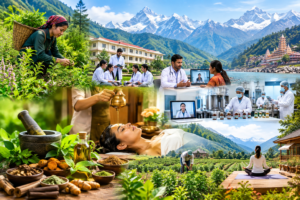
Few states have the combination of natural resources and institutional heritage that Uttarakhand possesses.
The Himalayan ecosystem provides a rich base of medicinal and aromatic plants, many of which have traditionally been associated with Indian systems of medicine. The state’s relatively clean environment, spiritual destinations and established tourism infrastructure add another dimension to its potential.
Uttarakhand also has a long history of Ayurveda education and traditional learning. The legacy of ancient gurukul and rishikul traditions, including institutions with roots extending back more than two centuries, provides a distinctive educational and cultural foundation.
This traditional base is now being complemented by modern Ayurveda education through Uttarakhand Ayurveda University and other institutions in the state.
From hospitals to primary healthcare
The expansion of Ayurveda in Uttarakhand is not restricted to specialised hospitals.
Government Ayurveda facilities, along with AYUSH wings and services associated with other healthcare institutions, are helping extend the reach of traditional systems of medicine. Strengthening AYUSH services at community and primary healthcare levels can make preventive healthcare and Ayurveda-based consultations more accessible to people in both urban and rural areas.
For a geographically diverse state such as Uttarakhand, strengthening healthcare access at the local level can be particularly important.
Building specialised Ayurveda services
The next stage of growth lies in moving beyond general Ayurveda services towards specialised care and centres of excellence.
There is growing emphasis on areas such as Panchakarma, Ksharasutra, lifestyle-related disorders, musculoskeletal conditions, neurological disorders and ophthalmic care.
Specialised services, when supported by trained professionals, appropriate infrastructure and documented clinical outcomes, could help Uttarakhand attract patients not only from other parts of India but also from international markets.
Technology meets traditional medicine
Digital technology is also beginning to change the way Ayurveda services can be delivered.
Tele-consultation platforms can connect specialists with patients in remote areas, while digital tools such as Prakriti Parikshan can help document individual health characteristics.
The larger opportunity lies in combining Ayurveda’s traditional knowledge base with modern systems of documentation, data collection and clinical research.
This could make Ayurveda more accessible while also generating evidence that can support its wider acceptance.
Medicinal plants could power a rural economy
One of Uttarakhand’s biggest opportunities lies outside hospitals—in its villages and mountain regions.
Scientific cultivation and conservation of medicinal plants can create an additional source of income for farmers and local communities. But the opportunity will depend on building an organised value chain—from certified planting material and cultivation to harvesting, processing, quality testing, manufacturing and marketing.
Simply collecting medicinal plants from forests cannot provide a sustainable long-term model. Cultivation, conservation and value addition will have to develop together.
A stronger value chain could connect farmers, researchers, pharmaceutical companies, healthcare institutions and tourism enterprises.
Education, research and industry need to move together
Uttarakhand already has an important base of Ayurveda education, including Uttarakhand Ayurveda University and a number of private Ayurveda institutions.
The next challenge is to create stronger links between education, research and industry.
Areas such as pharmacovigilance, drug standardisation, clinical research, quality assurance, medicinal-plant research and evidence-based documentation can become important pillars of this ecosystem.
For Ayurveda to expand globally, traditional knowledge must be supported by consistent quality, scientific documentation, standardisation and credible clinical evidence.
Industrial infrastructure adds another advantage
The presence of industrial areas and established manufacturing activity provides another building block.
Locations such as Selaqui, SIDCUL areas, Sitarganj and Kotdwar offer opportunities for developing and expanding Ayurveda and AYUSH-related manufacturing.
A stronger connection between these industrial clusters and local medicinal-plant cultivation could create a regional value chain, generating employment across agriculture, processing, manufacturing, packaging, logistics, research and healthcare.
Wellness tourism: Uttarakhand’s big opportunity
Perhaps the most visible opportunity is the convergence of Ayurveda and tourism.
Uttarakhand already attracts visitors for its mountains, pilgrimage centres, yoga traditions and natural environment. Adding professionally managed Ayurveda, Panchakarma, wellness and preventive-health programmes could create a new category of health tourism.
The state’s potential is not merely about attracting patients for treatment. It can also cater to people seeking healthier lifestyles, stress management, preventive healthcare, yoga, meditation, nutrition and rejuvenation programmes.
However, credibility will be critical. Wellness tourism will require trained professionals, standardised services, patient safety protocols, quality medicines, transparent pricing and proper documentation.
Towards an integrated ‘Ayush Pradesh’ ecosystem
Uttarakhand now has an opportunity to bring several seemingly separate sectors under one broader framework—Ayurveda education, healthcare, medicinal plants, research, pharmaceuticals, yoga, Panchakarma, wellness and tourism.
The state already possesses many of the basic ingredients: Himalayan biodiversity, traditional knowledge, Ayurveda institutions, healthcare infrastructure, educational resources, industrial areas and a strong tourism economy.
The real challenge is integration.
If these sectors are connected through a coordinated ecosystem, Uttarakhand can build a distinctive development model in which traditional knowledge supports modern healthcare, rural communities participate in the medicinal-plant economy, educational institutions drive research, industries create value-added products and tourism brings wellness services to a wider market.
Quality will determine global credibility
The growing popularity of Ayurveda also brings greater responsibility.
Quality control, standardisation, scientific validation, rational use of medicines, pharmacovigilance, research and proper training will determine how effectively Ayurveda expands beyond its traditional markets.
The objective should not be to choose between traditional knowledge and modern science. The greater opportunity lies in bringing the two together—preserving classical knowledge while subjecting therapies, medicines and practices to rigorous documentation and appropriate scientific evaluation.
For Uttarakhand, the opportunity is therefore much larger than developing a few additional Ayurveda hospitals.
It is about creating an integrated Ayurveda economy linking the mountains to laboratories, farmers to pharmaceutical companies, universities to research centres and wellness tourism to healthcare.
With its unique combination of nature, knowledge, education and tourism, Uttarakhand has the potential to emerge as one of India’s important centres for Ayurveda, wellness and preventive healthcare.
Dr Rajiv Kurele
Associate Professor & Academic Superintendent, Main Campus
Faculty of Ayurveda, Uttarakhand Ayurveda University, Harrawala, Dehradun