

Eight-decade-old multipurpose dam project to strengthen water security, irrigation and power generation across Upper Yamuna basin
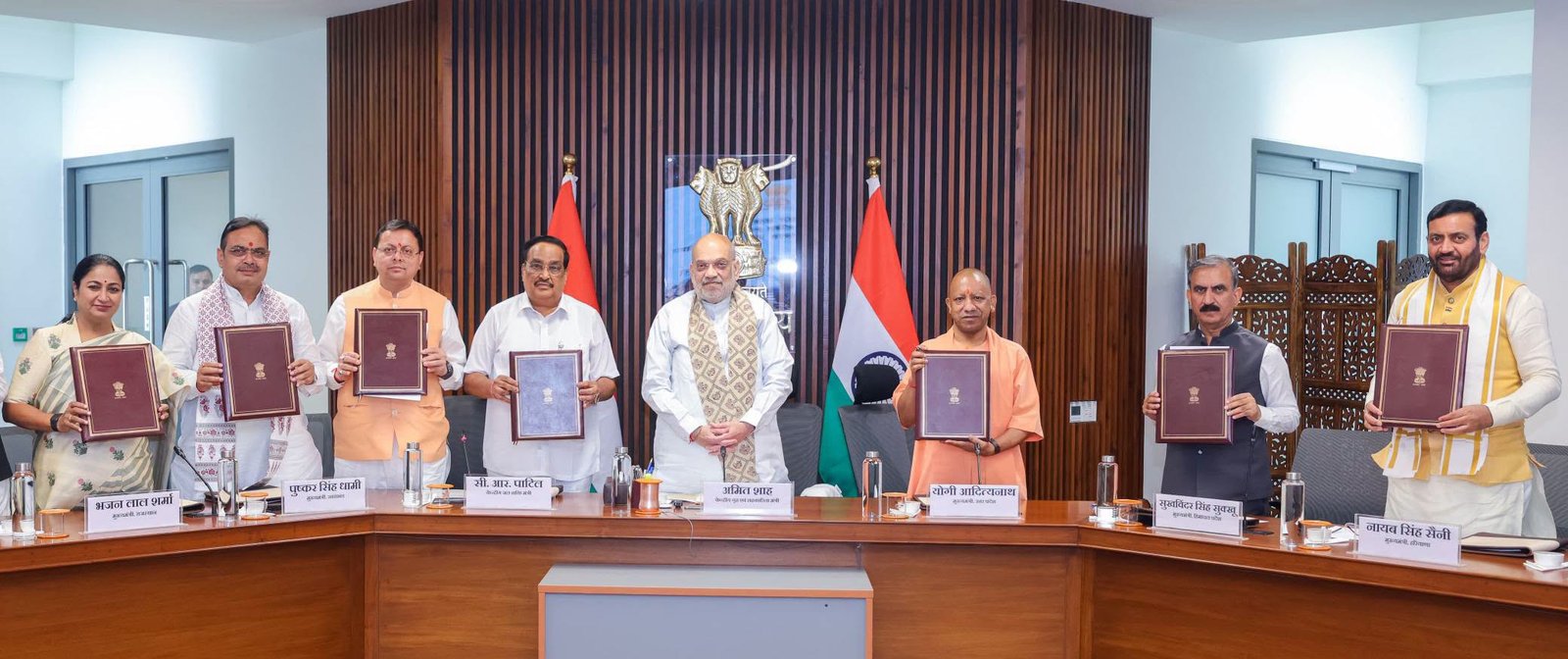
Dehradun/New Delhi: The long-pending Kishau Multipurpose Dam Project received a major push on Tuesday with Uttarakhand, Himachal Pradesh, Uttar Pradesh, Haryana, Rajasthan and Delhi signing a Memorandum of Understanding (MoU) for its implementation at a high-level meeting chaired by Union home and cooperation minister Amit Shah at Kartavya Bhavan in New Delhi.
The agreement is being seen as a significant step towards strengthening water security, irrigation and drinking water supply, besides boosting power generation and contributing to the rejuvenation of the Yamuna river. The project has remained on the drawing board for nearly eight decades.
Chief minister Pushkar Singh Dhami described the signing of the MoU as a “historic step” towards finally taking the Kishau project to the ground. Expressing gratitude to the Centre and the participating states, Dhami said the agreement marked more than just the signing of a formal document and represented a decisive breakthrough for a project that had been awaited for generations.
The Kishau project was first conceptualised in 1940. Despite several attempts over the decades to move it forward, the project remained stalled due to various technical, administrative and inter-state issues.
Dhami said the project had gained fresh momentum under the leadership of Prime Minister Narendra Modi, with the Centre pushing several long-pending projects towards implementation.
He also thanked Union home and cooperation minister Amit Shah, saying his intervention and guidance during a meeting held on June 16, 2026, helped pave the way for resolving several issues associated with the project. Subsequent coordination between the Centre and the participating state governments resulted in significant progress, culminating in the signing of the MoU.
422 MW power generation capacity
The chief minister said Kishau was not merely a dam project for a particular state but a multipurpose project of national importance, with implications for water security, power generation, irrigation, drinking water and the rejuvenation of the Yamuna.
The project envisages the creation of a reservoir with a capacity of approximately 1,562 million cubic metres (MCM) and development of 422 MW of electricity generation capacity.
Its benefits are expected to extend beyond Uttarakhand and Himachal Pradesh to Uttar Pradesh, Haryana, Delhi and Rajasthan, covering a substantial part of the Upper Yamuna basin.
Dhami said the project also represented an important example of inter-state cooperation and cooperative federalism, with the Centre and participating states working together to resolve issues that had kept the project pending for decades.
Rehabilitation of affected families a priority
While welcoming the agreement, Dhami acknowledged that the construction of the project would also present several challenges, particularly concerning land acquisition, forest diversion and rehabilitation.
He said the fair, sensitive and dignified rehabilitation of families affected by the project would remain the Uttarakhand government’s top priority. Development, he said, must go hand in hand with protection of the interests and dignity of affected families.
The project is expected to require the transfer of around 2,500 hectares of forest land, which in turn will create a substantial requirement for land for compensatory afforestation.
Dhami pointed out that arranging such a large area of land would be a major challenge for Uttarakhand, given that it is a predominantly forested and mountainous state. He urged the Centre and all participating states to assist Uttarakhand in identifying suitable land for compensatory afforestation.
The chief minister said Uttarakhand remained committed to maintaining a balance between environmental protection and development. All statutory requirements relating to forests and the environment, he said, would be complied with in accordance with the applicable rules.
‘Benefits to reach future generations’
Dhami expressed confidence that under Prime Minister Narendra Modi’s leadership and Amit Shah’s guidance, the participating states would be able to fulfil their collective resolve to implement the Kishau project within a defined timeframe.
He said the signing of the MoU should not be viewed merely as a formal exercise but as a historic milestone marking the beginning of implementation of a project whose benefits are expected to extend to future generations.
The chief minister also thanked Union jal shakti minister CR Patil, Uttar Pradesh chief minister Yogi Adityanath, Delhi chief minister Rekha Gupta, Rajasthan chief minister Bhajan Lal Sharma, Haryana chief minister Nayab Singh Saini, Himachal Pradesh chief minister Sukhvinder Singh Sukhu, Union ministers, representatives of participating state governments and senior officials for their cooperation in moving the project forward.
The agreement is expected to provide a renewed institutional framework for coordination among the Centre and the six participating governments and help take the long-awaited Kishau project towards the next stages of implementation.